Blood Pressure Basics
By Dr. Tasha · Board-Certified Internal Medicine Physician · 8 min read
The nurse wraps the cuff around your arm.
It squeezes. Releases. She glances at the monitor.
Then she reads a number out loud. Two numbers, actually — separated by a slash.
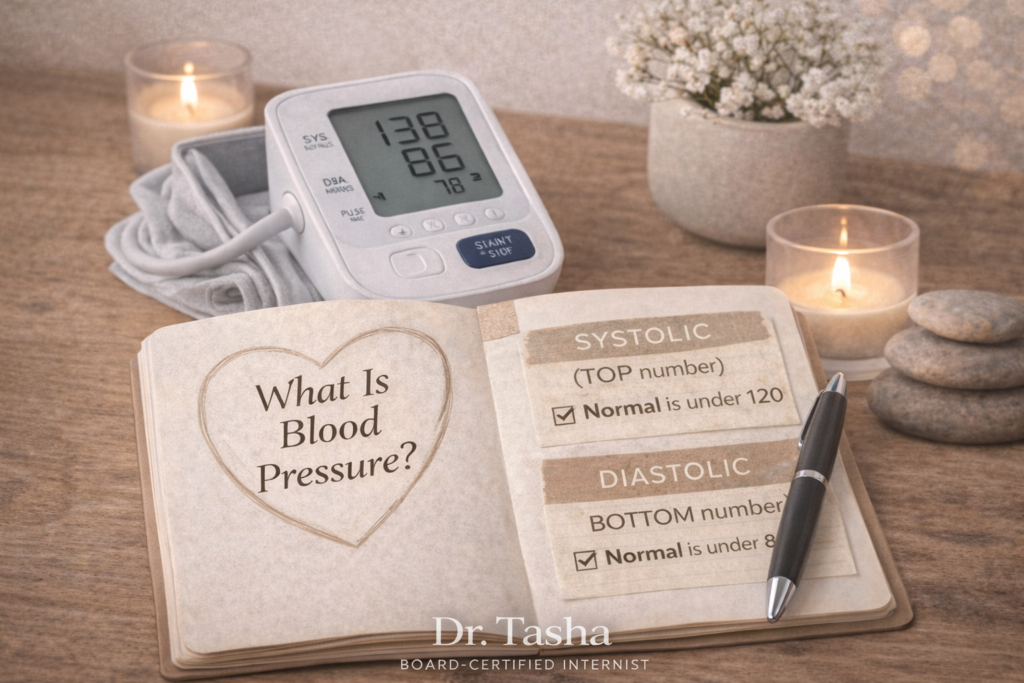
138/86.
You nod like you know exactly what that means.
But do you? Really?
Most people don’t. And that’s not a personal failing — nobody ever actually sat down and explained it.
You’re about to get the explanation you should have had 20 years ago.
In this post, I’m going to walk you through what blood pressure actually is, what those two numbers mean, what “normal” looks like, and why this number matters so much — especially after 40. No jargon. No overwhelm. Just a clear explanation you can actually use.
Key Takeaways
- Blood pressure is the force your blood puts on artery walls with every heartbeat
- The top number (systolic) = pressure when your heart beats. The bottom (diastolic) = pressure between beats
- Normal is under 120/80 — but “elevated” starts at 120, not 130
- Blood pressure changes constantly throughout the day — one reading is never the full picture
- After 40, the top number (systolic) becomes the more important one to watch
- High blood pressure often has no symptoms — one reason it’s sometimes called a “silent” risk
So, what exactly is blood pressure?
Your heart beats roughly 100,000 times a day, pushing blood through about 60,000 miles of blood vessels. Every time it pumps, that blood exerts force against the walls of your arteries. That force is your blood pressure.
Here’s a simple way to picture it. Think of a garden hose. When water is flowing, it pushes against the inside walls. If you squeeze the hose tighter — or crank up the water pressure — the force inside increases. Your arteries are the hose. Your blood is the water. Blood pressure is the force of that flow.
Some pressure is completely essential. It’s what moves oxygen and nutrients to your brain, heart, kidneys, and every other organ. The problem starts when that pressure runs too high for too long. Over years, excessive force damages artery walls, strains the heart, and silently sets the stage for heart attack, stroke, and kidney disease.
And here’s what makes this so dangerous: you can’t feel it. There’s no pain, no warning signal, no obvious sign that anything is wrong. Blood pressure can be elevated for years — affecting organs the entire time — while you feel completely fine. High blood pressure often has no symptoms, which is one reason it’s sometimes called a “silent” risk.
I know this personally. I’m a physician who treats hypertension every day — and my own blood pressure was quietly climbing to 154/91 before I caught it. No symptoms. No warning. Just a routine check that changed everything.
What do the two numbers actually mean?
When you see a reading like 138/86 mm Hg, you’re looking at two separate measurements taken in the same moment — one when your heart is working, one when it’s resting.
The Top Number
Systolic pressure — when your heart beats
Systolic captures the pressure in your arteries at the exact moment your heart contracts and pushes blood out. This is the peak force — the highest pressure your arteries experience in each cycle.
After 40, systolic is the number your doctor watches most closely. As arteries naturally stiffen with age, systolic pressure tends to creep upward even when everything else looks fine. Isolated systolic hypertension — high top number, normal bottom number — is the most common form of high blood pressure in adults over 50. In large studies, higher systolic pressure is associated with progressively higher risk of stroke and heart disease — a pattern that becomes more significant after age 40.
The Bottom Number
Diastolic pressure — between beats
Diastolic measures the pressure in your arteries when your heart is resting between beats — the lowest pressure point in the cycle. Your arteries never fully decompress, which is why this number is never zero.
Diastolic still matters. A very low diastolic (below 60 mm Hg) can be concerning — especially if you’re on blood pressure medication — because it may signal the heart isn’t filling adequately between beats. Don’t ignore it just because it’s the “smaller” number.
Quick Note
The “mm Hg” after a blood pressure reading stands for millimeters of mercury — the unit used since blood pressure was first measured using mercury instruments. Modern monitors are digital, but the unit stuck. You don’t need to think about it beyond knowing it’s the standard.
Free Resource
Download the Free DASH Recipe Book
50 blood-pressure-friendly meals for real life — fast, flavorful, actually doable.
The blood pressure categories — where do your numbers fall?
The American College of Cardiology and American Heart Association updated the blood pressure guidelines in 2017. These are the categories used today — and one of them often surprises people.
Category 1
Normal — Under 120/80
This is where you want to be. Optimal cardiovascular health is actually associated with readings closer to 115/75 — so the lower end of “normal” is genuinely better than the higher end. If you’re here, keep doing what you’re doing and don’t take it for granted.
Category 2
Elevated — 120–129 systolic (with diastolic under 80)
This one surprises people. 120–129 is not fine. It’s not something to monitor and ignore. Research shows cardiovascular risk is meaningfully higher in the elevated range compared with readings under 120. This is actually the window where lifestyle changes work best — and where many people can avoid ever progressing to Stage 1. Act now, not later.
Category 3
Stage 1 Hypertension — 130–139 / 80–89
Stage 1 warrants a conversation with your clinician. Whether medication is recommended depends on your overall cardiovascular risk profile — but lifestyle changes are appropriate and beneficial for everyone at this level. One important note: the guidelines use “OR” here — meaning if either number puts you in Stage 1, that’s your category, even if the other number looks fine.
Category 4
Stage 2 Hypertension — 140+ / 90+
Stage 2 typically requires medication alongside lifestyle changes. This isn’t a failure — it’s just where biology is right now, and medication is doing important protective work for your organs while lifestyle changes build. Don’t skip the lifestyle work because you’re on medication. Both together work better than either alone.
⚠️ Hypertensive Crisis
180+/120+ — Recheck first, then act
Step 1: Sit quietly for 5 minutes, feet flat on the floor, arm supported at heart level. Recheck with proper technique before doing anything else.
Step 2 — Call 911 immediately if you have any of these symptoms: chest pain, severe headache, shortness of breath, vision changes, confusion, sudden weakness, or difficulty speaking. These are signs of a hypertensive emergency.
Step 3 — Still elevated but no symptoms: Contact your clinician urgently or go to urgent care or the ER the same day. Do not wait until your next scheduled appointment.
Why blood pressure changes throughout the day — and why that’s normal
Here’s something most people don’t realize: your blood pressure is never the same number twice. It shifts constantly throughout the day — and that’s completely normal.
Normal reasons your BP fluctuates — and why that’s okay
- Physical activity — rises during exercise and returns to baseline after rest
- Stress and emotions — anxiety, excitement, and anger all cause temporary spikes
- Time of day — typically lowest at night, rises sharply in the morning with a cortisol surge, peaks in the afternoon
- Caffeine and food — certain foods and drinks cause short-term increases
- Cold temperature — causes arteries to constrict, temporarily raising pressure
- Talking or moving during a reading — can add 10–15 points on its own
This is exactly why a single reading — especially one taken at a doctor’s office when you’re anxious, rushed, or just walked in from the parking lot — is not the full story. What matters is your pattern over time, not any individual number.
White coat hypertension is real. Many people register consistently higher readings in a clinical setting purely because of the anxiety of being there. Home monitoring over several days, taken consistently at the same times, gives a far more accurate picture of what’s actually happening.
Related reading: Why Your Blood Pressure Won’t Budge After 40 · Blood Pressure Chart: Know Your Numbers
Why blood pressure gets harder to manage after 40
You may have had perfectly normal blood pressure your whole life — then watched it start climbing in your 40s or 50s without changing anything obvious. That’s not a mystery. That’s predictable biology.
Three things that change after 40
1. Arterial stiffness. Your arteries are like garden hoses that have been left in the sun too long – they gradually lose their flexibility. Stiffer arteries mean more resistance with every heartbeat, which pushes systolic pressure upward. This happens even in healthy, active people. It’s age-related physiology, not a personal failing.
2. Hormonal shifts. In women, the decline of estrogen during perimenopause and menopause removes a significant natural protective effect on blood vessel flexibility. That’s why many women who were 120/75 for decades suddenly find themselves at 138/88 – without changing anything. In men, gradual testosterone decline often accompanies metabolic changes that affect blood pressure regulation.
3. Accumulated lifestyle factors. Decades of chronic stress, disrupted sleep, creeping sodium intake, and gradually reduced activity compound over time. What your body absorbed easily at 30 it handles differently at 50. It’s not about one bad choice – it’s the accumulation.
None of this means rising blood pressure after 40 is inevitable or untreatable. It means you need a strategy built for the biology of midlife – not the same generic advice handed to every age group.
Your Starting Point
Three things to do this week
- Check your blood pressure at home – morning and evening, two readings each time, one minute apart
- Write down the numbers AND what was happening – context turns numbers into information
- Find your category on the chart above – then read why your blood pressure won’t budge after 40 to understand what’s driving your numbers
Frequently Asked Questions
What is a normal blood pressure reading?
Normal is under 120/80 mm Hg per the 2017 ACC/AHA guidelines. Optimal is closer to 115/75. Importantly, “elevated” starts at 120 systolic — not 130. If your top number is between 120 and 129 with a diastolic under 80, that’s the elevated category and it warrants lifestyle changes now.
Which number matters more — the top or the bottom?
Both matter, but after 50 the top number (systolic) gets more clinical attention. Age-related arterial stiffening pushes systolic up while diastolic often stays stable or drops. Isolated systolic hypertension — high top, normal bottom — is the most common pattern in older adults and carries real cardiovascular risk.
Can blood pressure change from minute to minute?
Constantly. Stress, movement, temperature, caffeine, even talking during a reading can shift your number by 10–20 points. This is why patterns matter more than single readings. Home monitoring at consistent times over several days gives far more accurate information than any one clinic measurement.
What are the symptoms of high blood pressure?
Usually none — which is exactly what makes it dangerous. Most people with hypertension feel completely normal. The only way to know your blood pressure is to measure it. Occasionally, crisis-level readings may cause headache or visual changes, but these are not reliable warning signs and shouldn’t be waited for.
Is 130/80 considered high blood pressure?
Yes, under current 2017 guidelines. 130/80 falls in Stage 1 hypertension and warrants a conversation with your clinician. Whether medication is recommended depends on your full cardiovascular risk picture — but lifestyle changes are appropriate for everyone at this level and should start now, not after the next appointment.
My doctor says my blood pressure is “a little high.” Should I be worried?
“A little high” is worth taking seriously — not panicking over, but acting on. Research is clear that people who address elevated blood pressure early, before it climbs further, have significantly better long-term outcomes. This is actually the window where lifestyle changes are most powerful. Don’t wait for it to get worse before starting.
Now you actually know what blood pressure means
The next time a nurse reads you a number, you’ll actually understand what she said. You’ll know which number matters more after 40. You’ll know why one high reading isn’t a crisis. You’ll know where your numbers fall — and what, if anything, needs to change.
That clarity is worth more than it sounds. You can’t manage something you don’t understand. And now you understand it.
Next up: how to take your blood pressure correctly at home. Most people are getting readings off by 10–15 points — without realizing it — because of small but fixable technique mistakes. That post is next.
Your next calm step
Download the Free DASH Recipe Book
50 meals that support healthy blood pressure — ready in 30 minutes or less.
Board-Certified Internal Medicine Physician · 23+ years clinical experience
Sources & References
Whelton PK, et al. 2017 ACC/AHA High Blood Pressure Clinical Practice Guideline. Journal of the American College of Cardiology. 2018;71(19):e127–e248.
Lewington S, et al. Age-specific relevance of usual blood pressure to vascular mortality. The Lancet. 2002;360(9349):1903–1913.
American Heart Association. Understanding Blood Pressure Readings. heart.org. Accessed 2025.
Medical Disclaimer
The information provided in this article is for educational and informational purposes only and is not intended as medical advice, diagnosis, or treatment.
This content should not be used as a substitute for professional medical advice, diagnosis, or treatment. Always seek the advice of your physician or other qualified health provider with any questions you may have regarding a medical condition, including high blood pressure (hypertension).
Never disregard professional medical advice or delay seeking it because of something you have read on this blog. If you think you may have a medical emergency, call your doctor or 911 immediately.
The author is a board-certified physician, but this blog does not create a doctor-patient relationship. Individual results may vary, and the lifestyle interventions discussed may not be appropriate for everyone. Always consult your healthcare provider before making any changes to your diet, exercise routine, or medication regimen.